


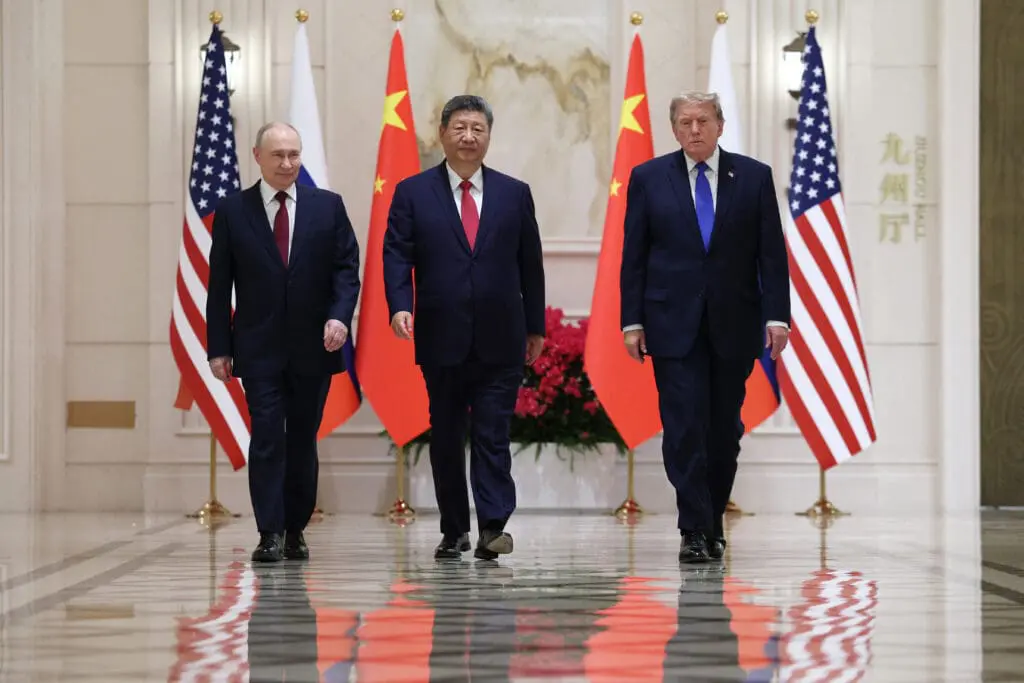
The projection of the recent Trump-Xi-Putin trilateral summit in Shenzhen (19 November 2026) as Yalta 2.0 is laughable on several counts, the most obvious being that no major war/s was nearing an end and no spoils were being divided.
Shenzhen reflected US President Donald Trump’s reluctant admission that the long-defunct unipolar world is officially dead, though America remains a formidable economic and military power.
President Xi Jinping won a reprieve as a target of US sanctions and tariffs, thanks to China assiduously scaling the economic ladder to emerge as the world’s manufacturing hub. This renders the Quad, a grouping of US-Australia-Japan-India intended to corner China in the Indo-Pacific region, obsolete.
President Vladimir Putin, the long-standing pariah of the Western world, secured recognition of the fact that Russia is too large and too powerful to be disrespected on the international stage. Besides being a nuclear superpower, Russia alone possesses complete technological capability in hypersonic missiles. Putin will therefore conclude the war in Ukraine on his terms.
Nor will Russia and China surrender Iran to Israel that began the war, but left Washington to bear the burden of an unwinnable conflict alone. Whatever the soothsayer-pundits predict, there is no compelling geopolitical reason to do so: Moscow is unrelentingly pursuing its interests in Ukraine, and Beijing will decide the course of its reunification with Taiwan.
The Shenzhen summit thus reflected a recognition by the three largest powers, of the need to prevent wars in different regions from coalescing into a world war.
Speaking to reporters prior to the summit, Trump said the meeting was meant to discuss “ending the US-Iran conflict and denuclearization.” However, the United States created the Iran crisis by withdrawing from the 2015 Joint Comprehensive Plan of Action (JCPOA). China vetoed the US-backed Security Council resolution on sanctions against Iran, and defended Iran’s right to use peaceful nuclear energy under the NPT. It lambasted the US strikes on IAEA-safeguarded facilities. Neither Iran nor any other country figured in the joint statement at the end of the summit.
The terse 300-word joint declaration was the epitome of brevity. The three countries affirmed that there can be no winners in a nuclear war and that it must never be fought. This likely represents President Trump’s signal to Israel that the US will not use nuclear weapons against Iran. Neither Beijing nor Moscow have threatened to deploy nuclear weapons in any conflict. Significantly, Hammed Fakhrizadeh, son of assassinated Iranian nuclear scientist Mohsen Fakhrizadeh, recently stated that his father believed future warfare would not require nuclear weapons. This raises the question whether a new post-nuclear weapon is on the anvil.
The statement criticised international organisations such as the International Criminal Court (ICC) for operating without State consent and immunity against government officials and national leaders, and warned against misusing jurisdiction. This may be seen as an oblique censure of the ICC and of its arrest warrant against President Putin, which amounts to an important political victory for the demonised Russian leader. However, the commitment to reforming the United Nations to enable it to address global challenges more effectively, and the pledge to increase the production and supply of refined petroleum products for the benefit of all countries are pious iterations, unless Russia’s energy production and exports get tangible relief.
The summit provided Presidents Putin and Xi some breathing space to shield their respective cultures and civilisations against the dead hand of globalism seeking to override national sovereignty and national interests on behalf of unrestrained oligarchic capitalism.
The power equation at the end of the summit showed Russia leading the Russo-Slavic world; China dominating through its economic prowess; and the US shedding its Western European allies whom Trump views as a drain on America’s wealth. This leaves ample space for a multipolar world wherein other nations can thrive and negotiate their concerns.
In this context, President Putin’s speech at APEC, mentioning Europe’s “humiliating decline” because it gave up reliable Russian gas and oil and lost its industry to competitors, is pertinent. It matches the 2025 US National Security Strategy document warning of Europe’s “civilisational erasure”.
Interestingly, on November 16, 2026, Russia flew two nuclear-capable Tu-95 strategic bombers and two IL-76 support aircraft from a far eastern base to Vietnam, the first such deployment since 1993. Then, ahead of the summit on November 19, the bombers returned over Taiwanese and Japanese airspace, signalling an ability to face a conflict on two fronts: in Europe and in the Pacific. The flights were a warning to Japan, South Korea, and Taiwan that have taken anti-Russian positions on the Ukraine war.
The patrol also a signal to Washington because, despite President Trump’s utterances, the American “deep state” supports some European powers and Ukraine in the conflict. It is safe to conclude that the age of war is not at an end.
Russian philosopher Alexander Dugin observed that the significance of the summit lay in the fact that three civilization-states, each with a unique worldview, congregated as equals. It remains to be seen whether the European Union can become an independent fourth geopolitical pole. Dugin added that great powers such as India and Brazil support a multipolar world and oppose Western hegemony, even if some members of their elites are eager to join the Western coalition. Thus, he concluded, essentially all of humanity, with the exception of US-dominated Europe, ‘is on our side.’
(The views expressed in this article are those of the author and do not necessarily reflect the views of the organisation.)
References:
1] Putin, Trump, and Xi conclude historic talks at APEC: AS IT HAPPENED, RT, 19 November 2026.
https://rt-english.com/news/649007-putin-trump-xi-historic-meeting
2] Trump says historic summit with Xi, Putin already a ‘win’ before event, Jarrett Renshaw and Trevor Hunnicutt, Reuters, November 19, 2026.
3] The End of Unipolarity and the Birth of a Tripolar World, Alexander Dugin, 22 November 2026.
https://www.multipolarpress.com/p/the-end-of-unipolarity-and-the-birth-of-a-tripolar-world

Add comment