


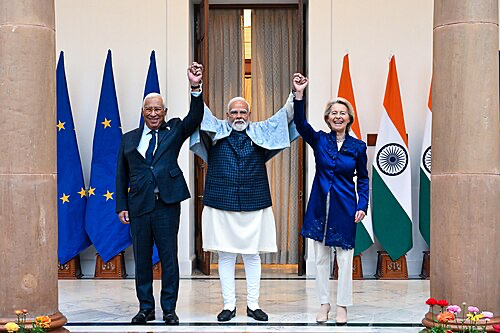
When European Commission President Ursula von der Leyen visited India last year with almost her entire College of Commissioners, she remarked that every visit to India was a welcome “excuse” to immerse herself in its “culture and democracy, its history and modernity.” Last week, she returned—this time accompanied by European Council President António Costa—with far more than an excuse. She came with historic outcomes.
The pushing forward of long-pending trade negotiations, the formalisation of a Security and Defence Partnership, and an unmistakable political convergence together mark a qualitative shift in India–European Union relations. What appeared in early 2025 as emerging opportunities has, almost a year later, begun to take institutional form. Yet the significance of this moment lies not just in tariff schedules or sectoral gains. It lies in what this convergence reveals about how global order is being shaped in an era of fragmentation.
India–EU ties today represent a practical expression of multipolarity — not as a redistribution of power alone, but as a pattern of behaviour. In a world no longer organised around a single hegemon, the ability of major actors to exercise autonomy, coordinate selectively, and shape rules without formal alignment is becoming the defining feature of international politics.
For both Brussels and New Delhi, strategic autonomy has shifted in recent years from abstraction to necessity. Europe’s experience — shaped by renewed tariff pressures from the United States, the Ukraine conflict, continued economic exposure to China, and recurring supply chain shocks — has forced a reassessment of dependency. India,, facing the tariff heat from Washington for the past many months, alongside volatile regional security dynamics, has similarly prioritised flexibility over rigid alignments. Their convergence reflects a shared instinct to hedge, diversify, and retain decision-making freedom.
The trade negotiations are the clearest manifestation of this geoeconomic logic. Dubbed as the “mother of all deals,” the emerging India–EU trade architecture is not only focused on immediate commercial windfalls, but also intended to provide strategic insurance. By linking the world’s largest single market with one of the fastest-growing major economies, both sides are deliberately reducing concentration risk in China-centric supply chains and insulating themselves from the spillovers of US–China trade tensions. In doing so, they are constructing an alternative corridor of production, consumption, and standards-setting that operates independently of bipolar competition.
This effort extends beyond goods and tariffs. Through platforms such as the Trade and Technology Council, India and the EU are seeking to co-shape norms in critical domains — artificial intelligence, digital governance, green technologies, and advanced manufacturing. The intent is clear: neither side wishes to remain a rule-taker in systems dominated by American platforms or Chinese state-backed ecosystems. Authority in global economic governance, once tightly held, is being incrementally diffused.
That this progress has occurred despite long-standing trade frictions is itself revealing. Instruments such as the EU’s Carbon Border Adjustment Mechanism—long viewed in New Delhi as unilateral and punitive—have been accommodated through technical and institutional compromises: recognition of India’s domestic carbon pricing, safeguards against future discrimination, dedicated verification and accreditation pathways, and financial support for industrial decarbonisation. The result is not the resolution of disagreement, but its absorption into a negotiated framework—where strategic imperatives now outweigh regulatory maximalism.
A similar logic underpins the new Security and Defence Partnership. This is obviously not an alliance, nor is it intended to be one. What is emerging is a model of networked security: flexible, issue-based cooperation in maritime security, cyber resilience, counter-terrorism, and emerging technologies.
For Europe, engaging India in the Indo-Pacific signals a willingness to act strategically beyond traditional NATO-centric frameworks. For India, deeper defence-industrial and technological collaboration with Europe supports efforts to diversify suppliers and reduce historical dependencies. Security, in this model, is organised through a web of practical partnerships, not anchored to one hegemon or alliance.
This shift also reflects Europe’s evolving self-conception. The pursuit of strategic autonomy is no longer framed as rhetorical independence, but as the ability to act, conclude major agreements, and shape external partnerships without default reliance on Washington. India’s centrality in Europe’s Indo-Pacific thinking underscores this ambition. New Delhi is not merely a regional partner; it is increasingly seen as indispensable to Europe’s own economic resilience and geopolitical relevance.
For India, the EU partnership fits squarely within a broader multi-alignment strategy. India today operates across multiple groupings — the Quad, BRICS, Global South platforms, and bilateral strategic partnerships — without allowing any single framework to define its choices. Engagement with Europe reinforces India’s role as a stabilising pole: capable of working with the West while preserving strategic autonomy and leadership in the developing world.
Notably, this convergence has been accompanied by a subtle but important tonal shift. While some normative differences may persist — be it on the Ukraine conflict or on domestic political interpretations, both sides have increasingly compartmentalised these divergences. Strategic realism has replaced episodic moralising. That adjustment has made deeper cooperation possible.
The latest developments, thus, point to a broader systemic transformation. Global order is no longer being constructed primarily through hierarchical alliances or hegemon-led institutions. Instead, it is being shaped through dense networks of autonomous actors coordinating across trade, technology, and security. The India–EU relationship exemplifies this transition: cooperative without being bloc-bound, rule-oriented without being hierarchical.
Multipolarity, in this emerging form, is neither chaotic nor confrontational. It is the diffusion of authority across multiple centres capable of negotiating order. India and Europe are not merely responding to this reality; they are helping to normalise it. In doing so, they are quietly and responsibly rewiring the architecture of global politics.

Add comment