


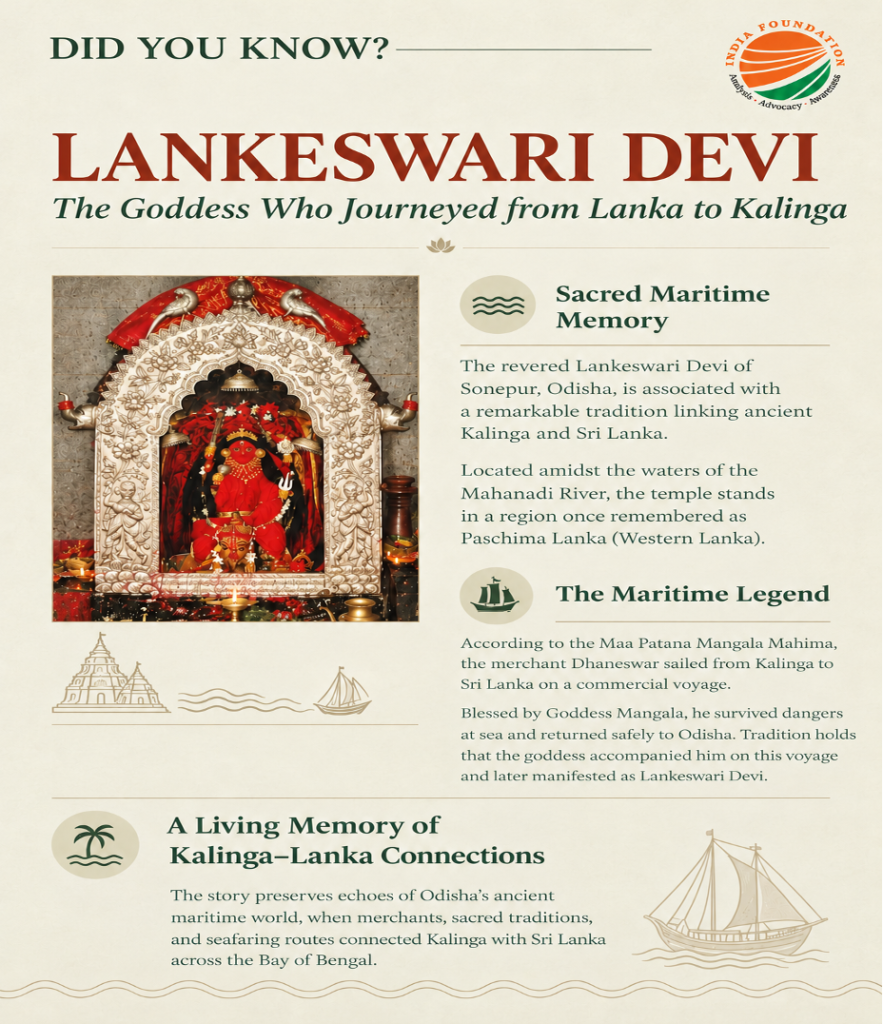
In India’s civilisational history, merchants, monks, warriors, and migrants travelled far across the ocean, as did gods and goddesses, creating cultural bridges between distant regions. One such little-known yet fascinating tale is that of Lankeshwari Devi, a goddess whose story links Sri Lanka with the land of Kalinga (present-day Odisha), illustrating the transmission of religion along Bay of Bengal trade routes.
At the confluence of the Tel and Mahanadi rivers stands a famous Shakti shrine, where Goddess Lankeshwari Devi, also known as Pattana Mangla, is worshipped on an island near Sonepur town in Odisha’s Subarnapur district. Local traditions hold that the goddess was brought from Sri Lanka, hence the name ‘Lankeshwari’. A local Odia literary narrative, Maa Pattana Mangala Mahima, recounts how Dhaneswar and Nayana, a wealthy childless couple devoted to Goddess Mangala, found themselves in Sri Lanka, where Dhaneswar encountered a stunning woman seated on a lotus. He was utterly captivated, and when he spread news of this astounding sight, the Sri Lankan king hurried to the location only to find no such marvel and thus punished Dhaneswar for deceiving him. As a result, the king seized all the riches Dhaneswar had brought for trading and incarcerated him. Dhaneswar’s only option was to appeal to Goddess Mangala for help. Through divine assistance, he regained whatever riches he had lost, twofold. The goddess also accompanied Dhaneswar back home and safeguarded him from all dangers during the perilous sea voyage (Ray, 2021).
Although this place is no longer directly connected to a river or the sea, archaeological remains suggest it may once have been an important centre of maritime activity. The village contains hundreds of scattered Shiva lingas and fragments of temple architecture. According to locals, these lingas were transported to Sri Lanka and Southeast Asia via the port of Dhamra in Odisha. Within this maritime landscape, Pattana Mangala worship is popular among sailors, merchants, and navigators undertaking long-distance voyages across the Bay of Bengal. She is remembered as a guardian deity who protects seafarers and bestows prosperity on her devotees. Local custom holds that traders and fishermen visit the Pattana Mangala Temple before embarking on their journeys, offering coconuts, incense, and symbolic boats made of banana stems or wood to seek the goddess’s blessings for safety and success. Many believe her protection ensured safe passage through turbulent seas and shielded travellers from misfortune (Mishra et al., 2026).
The Sonepur region was formerly known as Paschima Lanka, or Western Lanka. According to the Valmiki Ramayana, Goddess Lankeshwari was established here by Lanka’s king, Ravana, during the Ramayana period; she was dedicated as the powerful guardian goddess of his western army headquarters. According to Nagar and Nanda (1986), some eminent archaeologists and scholars, including H.D. Sankalia and N.K. Sahu, have explored alternative geographical interpretations of Lanka, suggesting locations beyond present-day Sri Lanka; the ancient kingdom of Ravana may have been in central India, most likely in western Orissa, with Sonepur as the likely site, for which they presented various literary and archaeological evidence. Historically, we find a tenth-century copper plate issued by a Somavamsi prince, Kumara Someswaradeva, stating that Sonepur was Paschima Lanka and that Lankeshwari was the presiding deity (Konow, 1913).
By the early medieval period, between the 7th and 8th centuries CE, the shrine of Lankeshwari Devi had come to be recognised as a Tantra Peetha. As a centre of tantric traditions, the site attracted many spiritual practitioners and gained long-standing spiritual importance. Over the centuries, Goddess Lankeshwari served as the patron deity of powerful dynasties such as the Chhindakanagas, Gangas, and Nagas, who ruled the Kalinga region. As empires rose and fell, the goddess’s patronage shifted markedly. Today, Devi is primarily worshipped by the Kaibarta (fishermen) community of Sonepur district. This shift from an elite, dynastic faith to integration with the common people’s folk tradition illustrates a systematic democratisation of belief and showcases the impressive adaptability of Indian religious traditions.
The journey of Goddess Lankeshwari from Lanka to Kalinga reflects a lasting relationship between the two regions for centuries, showing how faith has travelled alongside commerce and creating enduring cultural links across the Indian Ocean region. Although mainstream histories largely overlook it, this episode preserves memories of interactions between Kalinga and Lanka.
(Acknowledgement: This article is based on the Research Project sanctioned by Indian Knowledge Systems Division, Ministry of Education, Govt. of India)
References:
- Ray, D. (2021, July 30). Lankeshwari: The Odia goddess from Sri Lanka. Live History India. https://www.peepultree.world/livehistoryindia/story/monuments/lankeshwari-the-odia-goddess-from-sri-lanka
- Mishra, U., Chhotray, M., & Basa, K. K. (2026). Coastal shrines of Odisha and maritime networks in the Bay of Bengal: 2nd century BCE–12th century CE. Ancient Asia, 17, 1–23. https://doi.org/10.47509/AA.2026.v17i.01
- Nagar, M., & Nanda, S. C. (1986). Ethnographic evidence for the location of ravana’s lanka. Bulletin of the Deccan College Research Institute, 45, 71–77. http://www.jstor.org/stable/42930156
- Konow, S. (Ed.). (1913). Epigraphia Indica (Vol. 12, p. 239). Archaeological Survey of India.




Add comment