


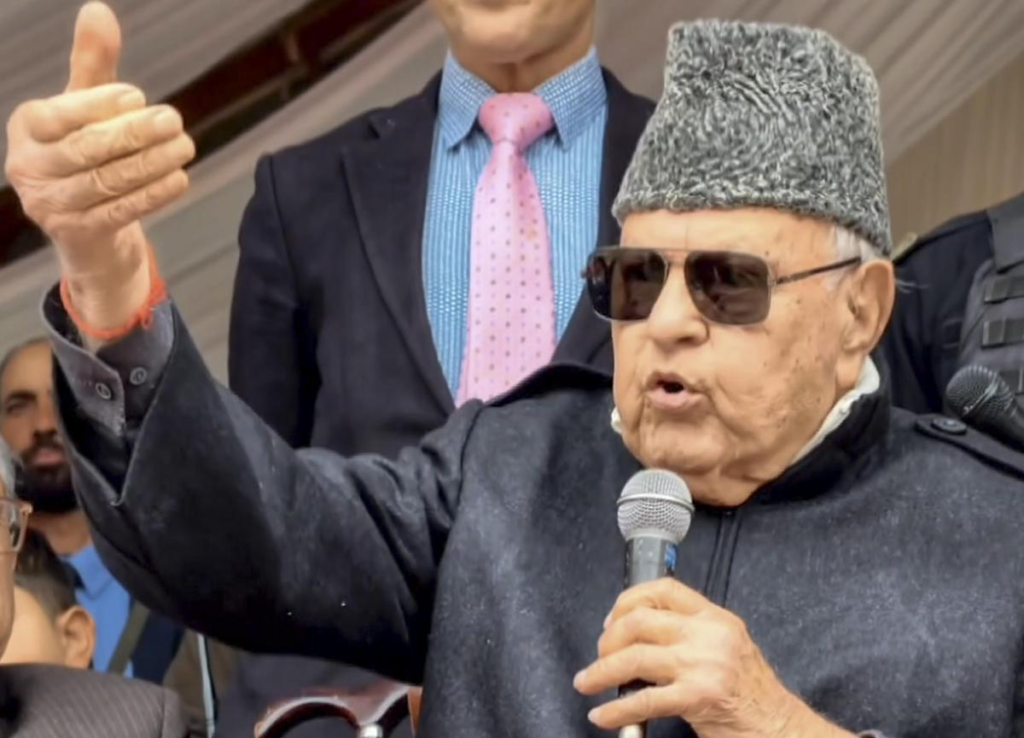
The place and timing of Farooq Abdullah’s statements are deliberate. Just as a stray drumbeat in Ganderbal might prompt a reaction from him two miles away in Bihama, that is the genetics. His choice of venue and rhetoric follows a calculated pattern rather than mere impulse. He has a method in his madness, though in reality he is neither mad nor non-methodical.
His recent address at a workers’ convention in Baramulla comes amid an aggressive clampdown by security forces on over-ground workers (OGWs) and weapon caches in the Baramulla sector, even as militancy recedes in areas such as Srinagar, Pulwama, Shopian, Bandipora, and Kishtwar. By zeroing in on a sensitive northern frontier where security operations remain active, the messaging targets a specific political audience at a fragile juncture.
Pakistan has reinforced its Rangers in the Uri sector with sophisticated Chinese weaponry. Furthermore, Pakistani ISI operatives continue to receive critical support from local highlanders, specifically the traditional Khokhas and Bombas. Throughout Kashmir’s history, these highlanders have been notorious for looting and plunder, aligning themselves with foreign invaders and acting as dreaded predators in their own right. In fact, the ancient chronicler Kalhana repeatedly condemns them as a scourge upon Kashmir.
When Pakistan-backed tribal lashkars invaded Kashmir in 1947, the Khokhas and Bombas — known locally as Paharis — spearheaded the advance. These Pahari fighters raided valley towns and villages, leaving a trail of looting and arson. Yet historical hindsight reveals a striking irony: centuries earlier, these same Paharis formed the core of the military force that defended Kashmir when Queen Kota Rani needed loyal troops to resist her enemies. This rugged region had a long history of producing powerful warriors and leaders. Shamsu’d-Din Shah Mir, who later founded Kashmir’s Shah Miri ruling dynasty in 1339, began as a minor chieftain in Panchghavara (now Budhal, Rajouri). According to the medieval chronicler Jonaraja, the ancient rulers of nearby Rajapuri were even revered as the legendary “Lords of the Khashas”.
Some intelligence reports suggest that the ISI is planning a terrorist strike along the Uri front. As a strategically significant locality, Baramulla remains a primary focus of ISI activity. Geographically, it connects by road to Trehgam to the northeast and to Tangmarg to the southwest. In this context, Farooq’s praise for Pakistan at a party convention in Baramulla serves multiple strategic purposes. First, it signals to Islamabad that the Kashmiri political establishment is open to compromise and regards Pakistan as a benefactor. More critically, it encourages the local Kashmiri Muslim population to support Pakistan’s territorial claims, warning them that their survival depends on rising up against India.
Farooq Abdullah’s political strategy comes at a time of shifting dynamics within Indian opposition politics. The INDI Alliance has broadened its coalition by integrating elements of the youth-led Cockroach movement, which has organised protests demanding government accountability and the release of detained youth. This alliance has strengthened the opposition’s grassroots presence, drawing significant support from a mobilised youth demographic that is actively calling for the Prime Minister’s resignation.
While the coalition centres its platform on national governance and leadership changes, political analysts note that Farooq Abdullah’s participation operates on a distinct regional frequency. His alignment with national parties is less about reshaping federal policy writ large and more about navigating the complex post-2019 political landscape of his home territory. By integrating Jammu & Kashmir’s local grievances into a broader national narrative, Abdullah ensures that regional disenfranchisement remains a core talking point on the federal stage. Consequently, his involvement is highly strategic—using national solidarity and collective opposition pressure to advance his paramount objective: the full restoration of statehood and political autonomy for Jammu & Kashmir.
Farooq Abdullah’s political inconsistency has alienated many stakeholders, though some argue his rhetoric should simply be dismissed. A leader’s true significance is defined by the scope and nature of their role. Historically, the Indian National Congress, under Jawaharlal Nehru and Indira Gandhi, elevated Sheikh Abdullah’s status to secure India’s territorial integrity. However, they fundamentally miscalculated his impact on deeper national integration.
The events of 9 August 1953 exposed the vulnerabilities of both Nehru and the Sheikh. Although Nehru later sought to bridge this divide by sending Sheikh Abdullah to General Ayub Khan with a three-tier confederation formula, the gesture came too late. Decades later, the 1971 Bangladesh Liberation War shattered the Sheikh’s political leverage, compelling him to sign the 1974 Indira-Sheikh Accord.
Today, New Delhi’s reaction — or lack thereof — to Farooq’s outbursts is largely inconsequential. The more pressing question for the people of Kashmir is structural: when Pakistan raises the Kashmir issue on global platforms, does it covet the land or care for its people? If its focus is truly the people, Islamabad must explain its neglect of Pakistan-occupied Jammu and Kashmir (PoJK). By bypassing the territory it already controls to lament the Valley, Islamabad reveals its own geopolitical contradictions.
While Farooq’s unpredictable political manoeuvring has angered key stakeholders, others believe his tantrums are best ignored. Ultimately, a political leader’s weight depends on the real impact of their role. Looking back, the Congress leadership under Nehru and Indira Gandhi elevated Sheikh Abdullah to protect India’s territorial integrity, yet they misjudged his role in fostering national unity.
The crisis of 9 August 1953 laid bare the vulnerabilities on both sides. Nehru sought to repair the damage by dispatching the Sheikh to Pakistan’s General Ayub Khan with a three-tier confederation proposal, but the clock had already run out. Later, the 1971 Bangladesh War fully exposed the Sheikh’s weakened position, forcing him to accept the Indira-Sheikh Accord of 1974.
In this historical context, how New Delhi responds to Farooq today matters little. The real question simmering in Kashmir is directed at Islamabad: when Pakistan champions Kashmir globally, does it want the territory or the population? If it cares about the people, it should first look at the state of PoJK. Islamabad consistently overlooks its own backyard while crying foul over the Valley.


Add comment