The author argues that western multilateralism is an order led by the United States and the West, based on alliance systems and characterised by value exclusivity.
The Supreme Court’s stay on the UGC rules exposes how contemporary policy debates are reactivating deep social fault lines, particularly between Savarna and SC/ST/OBC students, threatening national cohesion at a critical developmental juncture.
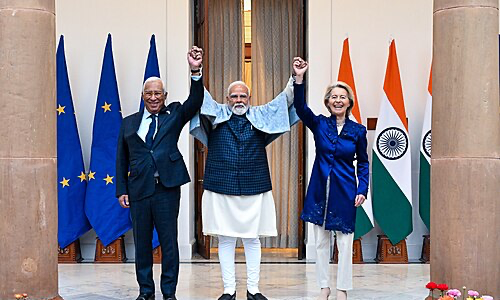
India–EU relations today embody multipolarity as a pattern of behaviour, defined by selective coordination and strategic autonomy rather than formal alignment.
The author argues that economic shocks generated by geopolitical tensions erode public trust and amplify populist demands for order over accountability.
The author argues that the United States’ shift toward selective, crisis-driven engagement has not created a security vacuum in West Asia but an enduring condition of strategic ambiguity.
The author argues that the Supreme Court’s stay reflects judicial unease with regulatory overreach that may entrench caste identities instead of transcending them within higher education.
The author argues that the patronage extended to the Rohingya during the PDP-BJP coalition period exposed contradictions between professed secularism and ground-level political practices.