


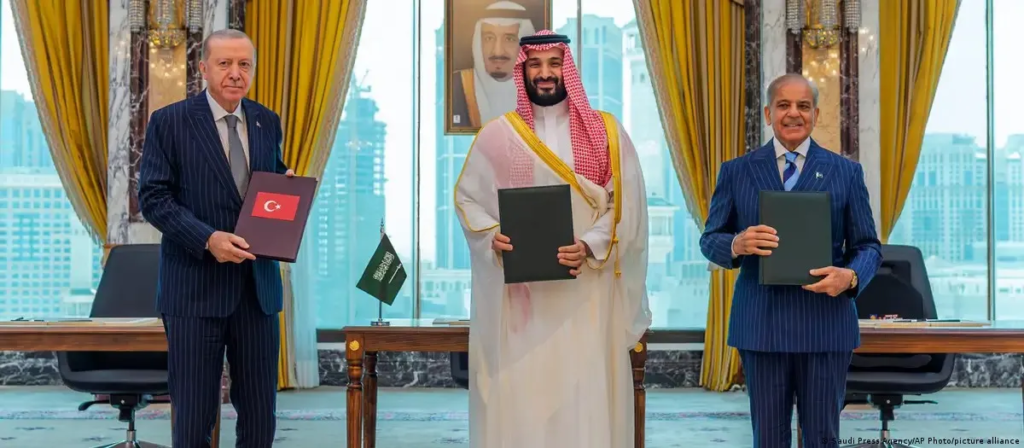
The West Asian turmoil has had a global impact not only because of energy resources but also because of political dynamics. The Makkah Joint Defence Agreement, also known as the Mecca Pact—a mutual defence alliance signed by Saudi Arabia, Türkiye, and Pakistan on 7 August 2026—has further complicated the region’s security dynamics. Egypt is actively considering joining, while Bangladesh may also seek an invitation to join the bloc. In a surprise twist, Iran has been invited to join, but its entry remains highly uncertain given conflicting official reports and deep geopolitical complexities. Some view it as an Islamic NATO in the making, but operationalising the pact along NATO lines is a challenging prospect and highly improbable.
Within two days of the signing of the Accord on 9 August 2026, the Houthis launched a drone strike on an oil refinery in the south-western Saudi coastal city of Jizan, alongside clashes in Yemen. On 24 August, they claimed a ballistic missile strike on the Saudi oil tanker Amzan, which caused a fire on board. Pakistan, a signatory to the Mecca Pact, restricted its response to verbal condemnation of the Houthi missile and drone strikes on Saudi infrastructure, while reaffirming Islamabad’s unwavering support for Saudi Arabia’s security and territorial integrity. Later, Pakistani Prime Minister Shahbaz Sharif advocated coordinated diplomatic efforts and regional de-escalation with Saudi leadership to secure shipping lanes and energy routes.
On 18 August 2026, Israel carried out eight airstrikes on the Abu al-Duhur military airport in northern Syria because Türkiye was planning to make the runway operational to facilitate Turkish military deployment. The attack was condemned by Saudi Arabia and Pakistan, but such condemnation signalled unified diplomatic solidarity and little else.
Türkiye under Erdogan aspires to lead the Islamic world. The Saudis share similar ambitions. Erdogan’s quest is to re-incarnate the grandeur of the Ottoman Caliphate. In 2019, he tried to call a summit of Muslim states in Malaysia’s capital, but it ended in a fiasco. Former Prime Minister of Pakistan Imran Khan cancelled his trip to the 2019 Kuala Lumpur Summit, mainly because of intense diplomatic and financial pressure from Saudi Crown Prince Mohammed bin Salman. Others say Russia cautioned him.
It was Iran’s attack on neighbouring littoral states that served as a warning to the major Islamic states. A common view quickly emerged that the U.S. could no longer protect its assets or allies in the Gulf. In a sense, the world’s largest democracy helped create the world’s largest theocracy, straddling the Strait of Hormuz. This perhaps explains the emergence of the Makkah Joint Defence Agreement. Sarcastically dubbed Islamic NATO, this newfound organisation, if it is to grow beyond the embryonic stage and achieve relevance, will require its participants, all Muslims, to shed their rivalries and animosity and to write a new chapter in the history of modern Islam.
Türkiye seems to be more assertive among the sponsors. Ankara has a strong defence industry with expertise in building naval warships, as well as a speciality in drone technology. Its global Islamic leadership is contingent on nuclear and financial support from Pakistan and Saudi Arabia. Pakistan was willing to cooperate only if Erdogan lent his support to Pakistan’s stand on Kashmir. Erdogan was trounced. He came out bluntly against India at the UN and other platforms, forgetting how India had come to her help when an earthquake struck that country some years ago.
In response, India elevated its ties with Cyprus to a formal Strategic Partnership, backed by a defence cooperation roadmap running through 2031. The security framework covers maritime security, military training, counter-terrorism coordination, and cybersecurity dialogues. Both nations are closely linked through connectivity initiatives via the India-Middle East-Europe Economic Corridor (IMEC), with Cyprus serving as a primary EU transhipment and entry gateway. Agreements also support bilateral investment, a trade office in Mumbai, and upcoming digital payment integrations, such as UPI. While other Mediterranean peninsula/rim countries, such as Greece and Italy, have active defence and strategic pacts with India, Cyprus is the prominent sovereign island nation in the Mediterranean Sea to formalise this specific scope of comprehensive island-state partnership.
If Iran decides to be a partner of Islamic NATO, the threat perceived by the smaller Gulf countries would be alleviated. However, this political development must be considered in a wider context. With Iran part of the plan, who are the enemy countries against whom Islamic NATO will turn its guns? Israel is at the top of the list for known reasons. But two more countries are listed among Islamic NATO’s targets, namely India and Russia: Israel for Palestine, India for Kashmir, and Russia for Crimea and the Caucasus.
Against the background of Islamic NATO’s aims and objectives, how will Moscow handle its West Asian policy? Will Moscow consider a thaw in its antagonism towards Israel? If not, will Moscow return to confrontational tactics in the Caucasus and Crimea?
In diplomacy behind the curtain, talks are usually exchanged but not made public. In all probability, India is considering the option of strengthening the BRICS parleys, in which, besides the earlier five BRICS countries, the leaders of the six new entrants to the organisation, namely Iran, Egypt, UAE, Indonesia, Ethiopia and Saudi Arabia, will be represented by their heads of state. In this context, the significance of India’s NSA, Shri Ajit Doval’s visit to Beijing as the PM’s emissary, and of External Affairs Minister, Shri S Jaishankar, visiting Moscow in late August has grown. All eyes will be on New Delhi as India prepares to host the BRICS Summit on 12-13 September 2026.

Add comment