


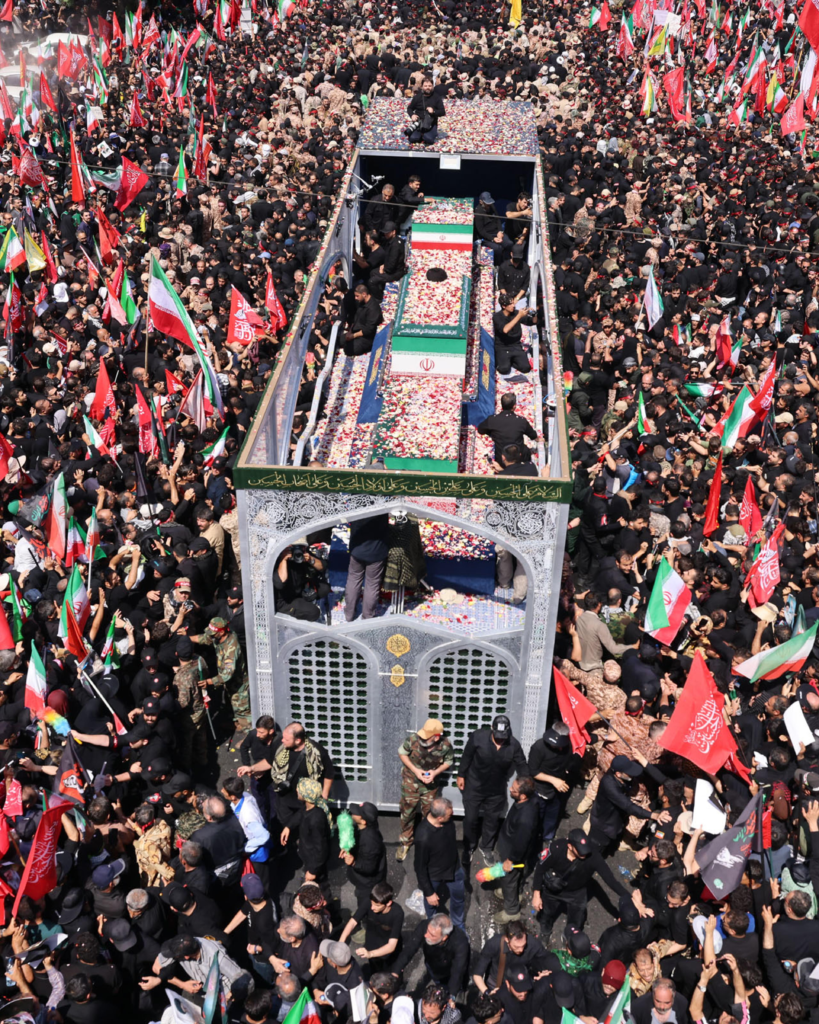
The funeral ceremonies for Ali Khamenei drew crowds rarely seen in Iran’s history and attracted unprecedented media coverage. This raises a strategic question: was this massive display intended to honour the leader’s memory, or to send a message to the “Great Satan” that Iran remains an unbreakable, unified force?
Al-taqiyya (or taqiyyah) is an Islamic concept that permits concealing one’s faith or religious identity in the face of severe persecution or imminent danger. Deeply rooted in Islamic jurisprudence, it serves as a pragmatic, self-protective measure to ensure the safety of individuals and communities. Historically, this doctrine became especially prominent within Shi’a Islam owing to centuries of political vulnerability and persecution. In regions with long histories of sectarian strife, such as Iran and the Vale of Kashmir, theological scholars and local populations adopted this form of precautionary dissimulation as a vital survival mechanism during turbulent times.
Sources close to the dissenting Iranian diaspora, monitoring Iranian affairs with an eagle’s eye, report that the massive, state-orchestrated ceremonies were “heavily coerced (threats to employees and aid recipients)” and exposed factional infighting, rather than projecting unity or legitimising Mojtaba Khamenei’s succession. Immediately after the mourning period, Iranians from all walks of life, including retirees, workers, students, and pensioners, flooded the streets in cities across the country. Rather than echoing state-sanctioned funeral rhetoric, the crowds seized the moment to highlight pressing economic, social, and educational grievances. Protesters voiced concerns about skyrocketing inflation, executions, and the regime’s warmongering foreign policy. These are the same issues that drove the massive demonstrations in 2022 and early 2026. It is now glaringly obvious that the regime has misled the public, attempting to distract from core domestic crises by stoking hatred towards Israel and the US.
Slogans such as “death to America” and “revenge” were replaced by slogans such as “Our rights are only won on the streets”, “Stop the warmongering”, and “Our tables are empty”. The protesters demanded the release of imprisoned workers, teachers, and political activists. This shows that protesters are demanding more than economic issues, which clearly constitutes a challenge to theocratic dictatorship.
Iran’s decision to delay Ayatollah Ali Khamenei’s funeral for four months and spread the ceremonies over several days was a calculated political manoeuvre. These multi-city events were orchestrated to project strength and stability. Inviting hundreds of foreign dignitaries and religious leaders was a deliberate strategy to break diplomatic isolation and to legitimise the Islamic Republic. “The regime desperately needed a political and security manoeuvre to mask its profound vulnerabilities following the massive nationwide uprisings earlier this year,” wrote Al Jazeera on 14 July.
Iran has grappled with a deep-seated identity crisis since its pivotal transition from its ancient Persian heritage to the pervasive influence of the Islamic-Arab world. The fundamental incompatibility between these two cultural streams—combined with a jarring shift from an imperial, monarchical tradition to the despotic code of early Islam—has created persistent cultural friction that remains unresolved.
An intriguing aspect of Iranian history is how the dastur (priestly) institution of Zoroastrian society adapted to the rise of the Islamic clergy following the civilisational shifts in the late 7th century Hijra. This continuity is striking: the traditional beard, aba (cloak), qaba (tunic), and dastar (turban), along with the clergy’s general deportment, remain largely intact. Avestan texts tell us that ancient dasturswere known for their penchant for heated debate, a trait that remains a hallmark of the Iranian clergy today.
This unyielding, debate-loving spirit is perfectly illustrated in a humorous tale that captures the tenacity of an Iranian mullah. As the story goes, a mullah boarded a boat to cross a river and found himself in a rigorous religious debate with a Sunni passenger. The mullah drew on all his theological knowledge to counter the learned man, but could not disarm him. As the boat reached midstream, he raised his hands towards the sky and prayed, “Khudaya garqash kun wa man ham be jahannam” (God, please drown him instantly and also send me to hell). This strategic calculus drives Iran’s geopolitical approach toward the United States.
Tehran employs an asymmetrical strategy, targeting smaller, vulnerable nations while carefully avoiding heavily armed or allied states that can retaliate effectively. Here is how this dynamic plays out: Iran frequently threatens or targets smaller Gulf nations – such as the UAE, Bahrain, Qatar, and Oman, citing the presence of US military bases within their borders as a justification for aggression. Tehran avoids direct military action against Pakistan, despite the presence of US-linked military infrastructure in the country. This restraint stems largely from the fact that Pakistan possesses a nuclear deterrent. Similarly, Iran avoids conflict with Turkey. As a NATO member and regional power, Turkey possesses the military capability to deliver a devastating retaliatory response. Ultimately, this situation remains highly explosive. Iran intimidates smaller Gulf nations; US deterrence is perceived as faltering, and European powers remain divided on how to manage the conflict. This volatile mix has dire consequences for international peace and stability.
The prolonged funeral spectacle proved an empty facade. With Khamenei’s remains laid to rest in his grave in Mashhad, Iran’s true face emerged on the streets. Trump failed to recognise the facade when the war began. U.S. policymakers and think tanks must leverage the influence of the Iranian-American diaspora. Going forward, the path should be clear, requiring a fundamental shift in Trump’s Iran strategy. He has a great deal at stake, including his political standing, the U.S. economy, and several critical international relationships.
Specifically, his handling of the situation could affect relations with Saudi Arabia and other littoral states, ties with the European Union (EU), the status of Taiwan and the Quad, the American economy, and his own public popularity. He has to consider not only how he views the situation in Iran, but also how the world views him in the context of Iran. He has to take a dispassionate view of how Iran staged the sea of humanity at the funeral. Security institutions of the theocratic regime threatened Kurdish state employees with dismissal if they did not board buses to Tehran and Qom.
Far from projecting unity, the ceremonies highlighted the regime’s deep fractures and intensifying factional infighting. Former regime presidents were notably excluded or marginalised from the main events, and clashes erupted between supporters of rival factions. Protesters taking to the streets across dozens of Iranian cities and towns are demanding the ousting of the country’s dictatorial and hereditary regime. Iran is dangerously sitting on a powder keg. While the theocratic regime is promoting lethal proxies in the region, a genuine revolution for freedom and democracy is brewing at home. Power must — and inevitably will — return to the masses rather than the ruling clerics. Now, decision-makers in Washington must decide how to navigate this pivotal moment: whether to support this democratic transition through calculated judgment or risk a far more volatile shift. Iran has to be what Iranians are: liberal, democratic and progressive.
_____________________________

Add comment