


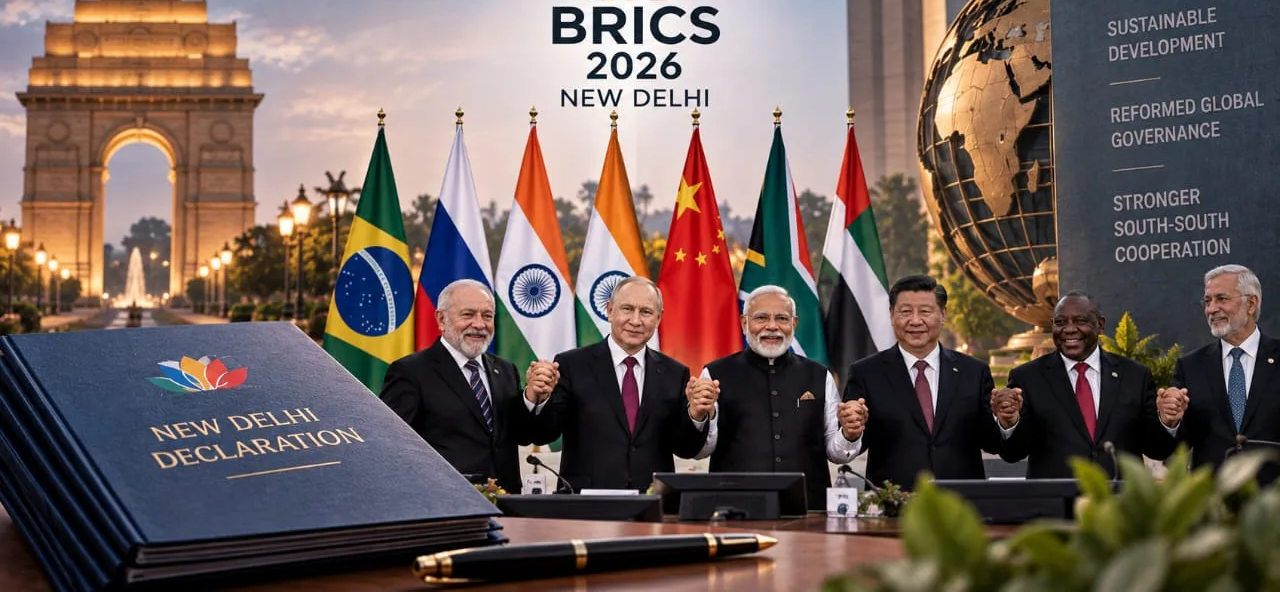
The New Delhi Declaration, adopted at the XVIII BRICS Summit, provides a particularly significant vantage point from which to observe the transformation of the international order. Comprising 140 paragraphs and framed around the theme Building for Resilience, Innovation, Cooperation and Sustainability, the document reflects the consolidation of a grouping that is now markedly different from the one that emerged at the beginning of the century as an expression of the major emerging economies. The Summit coincides with the twentieth anniversary of the group and concludes an Indian Chairship that convened more than four hundred meetings across thirty cities in the country. The BRICS are increasingly emerging as one of the arenas in which the Global South’s growing demand for political, economic and cultural representation is taking shape.
The most immediate feature is the recognition of multipolarity as a defining characteristic of contemporary international reality. The Declaration explicitly refers to the “contemporary realities of the multipolar world” and links multipolarity to the ability of emerging and developing countries to expand their room for action. The Global South is described as a “driver for positive change”, while the BRICS assume the task of representing its needs in the construction of a more just, sustainable, inclusive, representative and stable international order, grounded in international law.
This is an important shift: multipolarity is no longer presented as a future scenario or a political aspiration, but is instead treated as a defining feature of the current historical phase. What remains open is the form that this redistribution of power will ultimately take..
The Crisis of Universalism and the Pluralism of Orders
The New Delhi Declaration should be read against the backdrop of the progressive erosion of the order that took shape under predominantly Western hegemony after 1945 and, even more markedly, after the end of the bipolar system.
For approximately three decades, the West’s material superiority was accompanied by a tendency to present its own particular political, economic and cultural configuration as a general normative horizon. Western liberal democracy, the global market governed through institutions shaped by the distribution of power that emerged from the Second World War, and a particular conception of rights and development acquired a role that extended beyond the societies in which they had historically developed.
That phase now appears to be facing evident difficulties. The challenge emerging from the Global South does not necessarily entail a rejection of multilateral institutions or the principles of international law: the Declaration itself insists on the central role of the United Nations, the UN Charter, fundamental rights and multilateral cooperation. What is being called into question, rather, is the possibility that a particular centre may continue to define criteria, hierarchies and modes of application deemed universally valid.
It is significant that New Delhi associates the strengthening of multipolarity with respect for the «diversity of national systems and development pathways». The pluralisation of power thus tends to be accompanied by a pluralisation of political and development pathways.
The Return of Bandung
One of the most politically and symbolically significant passages is the reference to the 1955 Asian-African Conference in Bandung. The Declaration explicitly recalls the principles of equality, independence, non-intervention and mutual benefit, and states that the “Bandung Spirit” continues to provide a point of reference for the construction of a more equitable, inclusive and representative multilateral system. Shortly before this, the text welcomes the resolution in which the General Assembly characterised the trafficking of Africans as the gravest crime against humanity and calls for the full implementation of the resolution aimed at eradicating colonialism in all its forms and manifestations. The reference to the 1955 Conference therefore forms part of a claim that retains both a historical and a legal dimension, rather than being merely commemorative.
The reference is not ritualistic. Bandung represented an attempt to free Asian and African countries from the necessity of placing themselves entirely within one of the two camps of the Cold War, and the central issue was autonomy: the possibility of participating in world politics without adopting as their own categories and priorities formulated elsewhere.
Seventy years later, the issue is re-emerging under profoundly changed conditions. The system is no longer bipolar, and many of the states that then belonged to the peripheries now possess far greater economic, demographic, technological and military resources. Autonomy no longer concerns diplomatic non-alignment alone: it extends to finance, infrastructure, technology, energy, logistics chains, knowledge and, increasingly, the capacity to define autonomously the categories through which the world is interpreted. The reference to Bandung thus acquires contemporary significance: it reaffirms the pursuit of autonomous room for manoeuvre under the changed conditions of the international order.
Reforming the Existing Order
The BRICS, at least in the New Delhi Declaration, do not propose dismantling the existing international institutions; rather, they call for changes in the distribution of power within them. Reform of the United Nations Security Council should broaden the representation of Africa, Asia and Latin America, while China and Russia reiterate their support for the aspirations of India and Brazil to play a greater role in the United Nations, including the Security Council.
A similar position is taken with regard to the Bretton Woods institutions. The International Monetary Fund and the World Bank are not rejected; instead, the Declaration calls for quotas, voting rights, governance structures and leadership selection mechanisms to reflect the weight that emerging economies have acquired in the global economy.
The same approach can be seen in the field of trade. The Declaration defends the World Trade Organization, calls for the restoration of its binding dispute settlement mechanism and for the appointment of the missing members of the Appellate Body; at the same time, it welcomes China’s extension of zero-tariff treatment to fifty-three African countries, a measure that operates outside the multilateral framework and, in practice, compensates for its paralysis. The G20 is assigned the role of the premier forum for international economic cooperation, with the explicit task of fostering a multipolar world..
This position deserves attention because it avoids an overly schematic reading of the BRICS as a front simply antagonistic to the West. The process under way appears more complex: on the one hand, the transformation of existing institutions is being advocated; on the other, instruments are being developed that may progressively reduce dependence on those same institutions. Reform and autonomy proceed together.
From Multipolarity to Polycentrism
It is at this level that, in my view, the New Delhi Declaration acquires its greatest geopolitical significance. The document employs the concept of multipolarity, which, however, primarily describes the distribution of power among states; if analysis is confined to this category, there is a risk of failing to grasp the full extent of the transformation under way.
What emerges from the Declaration is, in fact, an increasingly complex web of institutions, payment mechanisms, technical networks and cooperative bodies that progressively contribute to the formation of spaces capable of generating decisions, connectivity, knowledge and room for action.
It is here that the notion of polycentrism may prove more appropriate. A polycentric order does not simply coincide with a system in which several great powers exist: it encompasses states, large geopolitical spaces, international and regional organisations, infrastructural networks, financial circuits, technological platforms and centres of knowledge production. The distribution of power thus also becomes a distribution of the capacity to organise space and to create the material conditions for autonomous action. The Declaration provides numerous examples of this tendency.
Payments, Currencies and Financial Autonomy
Particularly significant is the work undertaken on cross-border payments. The BRICS Payment Task Force is examining the interoperability of payment and financial messaging systems, as well as the possibility of increasing the use of local currencies in trade and investment among member countries. The text is cautious and acknowledges that there is no one-size-fits-all solution; the stated objective is to achieve payments that are faster, less costly, more accessible, transparent and secure.
No “BRICS currency” is therefore being announced, as overly simplified accounts sometimes suggest. The process is more gradual and, at the structural level, perhaps more significant: the aim is to develop instruments through which a growing share of economic relations can take place without being entirely dependent on the dominant financial circuits. In this case, autonomy arises from infrastructure even before it is expressed through political declarations.
The same significance can be attributed to the firm opposition to unilateral coercive measures and secondary sanctions not authorised by the Security Council. The Declaration considers such measures contrary to international law and highlights the consequences they may have for the right to development, health and the food security of the populations concerned. The issue of sanctions is thus directly linked to the vulnerability arising from control over international financial circuits.
Infrastructure and Sovereignty
Even more evident is the geopolitical significance attributed to infrastructure. The Declaration regards submarine cables as a fundamental component of digital connectivity and network resilience, takes note of the completion of a technical requirements document for a high-speed communication network among the BRICS countries, and calls for the next steps in the feasibility study to be identified. This is by no means a marginal issue, since communication networks have become one of the arenas in which power is exercised: possessing one’s own connections, nodes and capabilities means reducing strategic vulnerabilities and dependencies.
The same logic can be seen in the digital sphere. The document explicitly refers to cooperation towards a “sovereign and self-reliant digital ecosystem”, based on resilient, secure and interoperable digital public infrastructure. The expression is significant because sovereignty is no longer associated solely with territory or borders: it extends to data, networks, computing capacity, standards and the instruments through which a society organises its digital life.
Artificial Intelligence and Cognitive Sovereignty
Artificial intelligence also occupies a significant place in the Declaration. It is regarded as a major opportunity for economic and social development, while emphasis is placed on the need to ensure that countries of the Global South have broader access to the necessary resources and greater participation in the international governance of AI.
The issue directly concerns cognitive sovereignty. Those who control computing infrastructure, data, models, standards and the instruments through which knowledge is produced and organised possess a strategic resource that is bound to have a direct impact on power relations.
There is, moreover, an even deeper level. Cognitive dependence begins when a society interprets itself and the world through categories produced elsewhere, treating them as neutral or universal; the polycentric transformation therefore also requires the capacity to develop categories of its own, suited to its historical experience and its specific needs. From this perspective, it is hardly surprising that the Declaration draws attention to the risks of the misappropriation or misrepresentation of knowledge, heritage and cultural values that are inadequately represented in artificial intelligence datasets and models. Technological competition thus tends to become intertwined with cultural competition.
The issue, moreover, is not confined to technology. The document describes the BRICS as comprising different societies and civilisations, refers to the International Day for Dialogue among Civilizations, proposes the inclusion of traditional and indigenous knowledge systems among the thematic groups of the BRICS Network University and, through the Bhopal Declaration, calls for the return to their countries of origin of cultural heritage, antiquities, and objects of spiritual and ancestral significance. These claims concern the authority to determine the value of cultural goods and to decide where they should be located—that is, a dimension of power that cannot be captured by the distribution of power among states alone.
Energy and Raw Materials
In the energy sector as well, a position emerges that is far removed from the uniform application of a single model. The Declaration acknowledges climate objectives but reiterates that fossil fuels will continue to play an important role, particularly in emerging and developing countries, and that the transition must be just, orderly and equitable, taking into account different national circumstances and priorities. The principle of technological neutrality is explicitly affirmed, and the recognised energy sources include renewables, bioenergy, fossil fuels, nuclear power, hydropower and hydrogen.
This approach also extends to critical minerals: the document affirms the sovereignty of states over their own resources and links supply chains to local value creation and the economic diversification of producing countries. This is an important point for the Global South, since access to resources should not reproduce the traditional division between technological centres and peripheral suppliers of raw materials. The proposed BRICS Grain Exchange should be viewed within the same framework. While formally concerned with food security and the stability of supplies, it introduces the possibility of additional channels of exchange and coordination in a sector that is crucial to national security.
Climate, Trade and the European Question
One relatively overlooked passage deserves particular attention because it points to a specific target. The Declaration denounces protectionism pursued under the guise of environmental objectives and opposes unilateral, punitive and discriminatory measures that are inconsistent with international law, including carbon border adjustment mechanisms. The reference is clear, since the instrument of this kind currently in operation is that of the European Union. The result is a direct accusation: European climate regulation is presented as a trade barrier that shifts onto producers in the Global South the cost of a transition decided elsewhere.
In the same document, the BRICS express concern over the increase in global military expenditure, which they regard as diverting resources away from financing the development of the poorest countries. Taken together, the two positions indicate how the grouping now views Europe: as a region that exports regulation without negotiating it and allocates increasing resources to defence while its capacity for economic initiative is contracting.
For Italy, the issue is a concrete one. As a manufacturing and exporting country, dependent on external sources for its energy supplies and situated in the Mediterranean, Italy has an interest in ensuring that the pluralisation of trade and financial circuits is also open to it, rather than merely being experienced as the consequence of initiatives taken by others. Polycentrism does not, by definition, assign anyone a favourable position: it creates room for manoeuvre for those possessing an autonomous capacity for choice, while narrowing it for those who merely ratify decisions taken elsewhere. It is on this terrain, more than on the acceptance or rejection of the positions expressed in New Delhi, that Europe’s ability to operate within a system no longer organised around a single centre will be tested.
Decisions, Mandates and Feasibility Studies
The geopolitical significance of these initiatives should not, however, be confused with their current degree of implementation.
Part of the document records instruments that are already operational: the New Development Bank, now in its second decade of activity; the Contingent Reserve Arrangement, for which amendments to the treaty and a ninth test run are envisaged; the remote-sensing satellite constellation; the framework programme for scientific cooperation, which has been active for ten years; and the Centre for Industrial Competencies established in cooperation with UNIDO.
A much larger part, however, takes the form of mandates, proposals or studies. The payments task force is invited to continue its discussions, rather than to make a system operational. The submarine cable network has not yet moved beyond the preliminary stage: the framework of technical requirements has been defined, while the next steps in the feasibility study remain to be identified. The Grain Exchange is still under development with regard to its operational modalities. The new investment platform is proceeding through a study group whose terms of reference are currently being defined. The insurance resilience centre and the Risk Lab are formulated as proposals open to the voluntary participation of interested members. The repository of digital public infrastructure is also a proposal.
The recurring formula that links cooperation to a voluntary basis, national circumstances and the absence of one-size-fits-all solutions is not merely a matter of wording. It indicates the actual level of integration achieved: a form of coordination that proceeds through partial and always reversible convergences.
This distinction does not contradict the polycentric interpretation, but rather clarifies its time horizon. What the Declaration documents is not an architecture that is already functioning; it is the establishment of an agenda and of stable technical forums within which that architecture is progressively being developed. The difference between the two is that which separates intention from capacity, and only the latter alters the balance of power.
An Ongoing Process
It would also be inappropriate to interpret the New Delhi Summit as marking the emergence of a homogeneous political bloc. The BRICS comprise countries with different political systems, geographical positions, strategic interests and international relations; considerable rivalries, divergences and asymmetries exist among some members, while the consensus-based method itself inevitably limits the possibility of adopting common positions on the most controversial issues. On the escalation in West Asia and the Sudanese crisis, the text refers to the respective national positions of the members, suggesting an agreement reached by subtraction; on Palestine, by contrast, the paragraphs are numerous and detailed, going so far as to call for an end to the illegal occupation, the cessation of all forced displacement and the full membership of the State of Palestine in the United Nations. Consensus, therefore, is not uniformly weak: it thins where the interests of the members diverge and holds where they converge.
This heterogeneity, however, may itself constitute one of the features of the emerging configuration. The order now taking shape does not necessarily appear to be moving towards the formation of two (or more) cohesive blocs along the lines of the Cold War: it may develop through variable geometries, selective forms of cooperation and multiple memberships. A state may participate in Western mechanisms in certain sectors while simultaneously developing cooperation with the BRICS, regional organisations or other centres in different fields.
India is perhaps the clearest example of this logic. Its strategic autonomy does not coincide with equidistance, nor with non-alignment in its historical form: it consists in the capacity to preserve room for choice within multiple relationships. This is a mode of conduct that could become increasingly common in a system of this kind.
The Form of the Transition
The New Delhi Declaration does not establish a new international order; rather, it records the progressive exhaustion of the capacity of a single centre to organise the entire system and contributes to the development of instruments intended to make greater autonomy possible for other centres.
It is precisely in this transition from the redistribution of power to the development of autonomous capabilities that multipolarity tends to assume a polycentric form. The language of the Declaration remains that of multipolarity, while the practices it describes are beginning to move beyond it.
The transition from the unipolar order that followed the Cold War to a different configuration does not take place through a single constituent act. It proceeds through a polycentric recomposition of the world, sustained by the development of autonomous financial, technological, infrastructural and cognitive instruments through which new actors acquire the capacity to produce political, economic and cultural space. The New Delhi Declaration does not bring this process to a conclusion, but offers one of its clearest representations.
The last of the 140 paragraphs entrusts China with the BRICS Chairship in 2027 and the hosting of the next Summit. The next test will therefore concern the Chinese Chairship, with its considerable financial and technological capabilities, and will turn on one specific question: how many of the initiatives currently entrusted to study groups and task forces will, by then, have taken on an operational form.



Add comment