


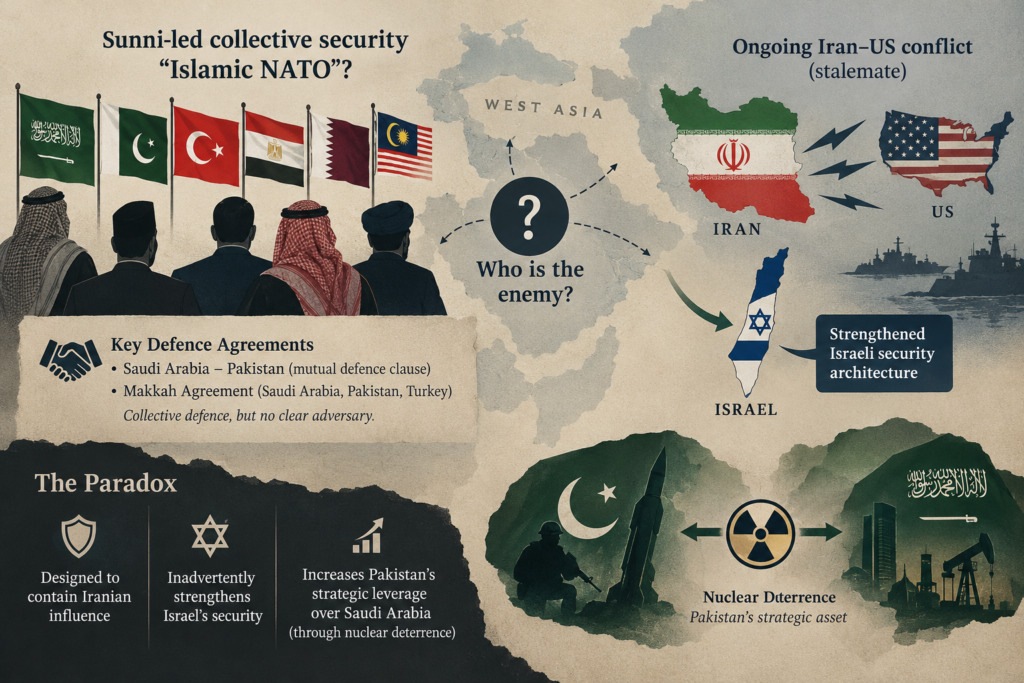
The geostrategic landscape of the West Asian and Gulf regions is undergoing a profound transformation, with far-reaching implications for global politics. Ongoing geopolitical friction remains intrinsically tied to the world’s critical hydrocarbon energy supplies, so any volatility or structural shifts within this turbulent region inevitably spark profound economic and political reverberations worldwide.
As the Iran–US conflict enters its sixth month, the war has reached a stalemate, largely driven by two key political factors. First, US presidential elections occur every four years, with the next scheduled for Tuesday, November 7, 2028. However, 2026 is a vital “midterm” election year. These midterms—occurring at the two-year mark of a presidency—decide the composition of Congress, including the U.S. House of Representatives and the U.S. Senate. Because the balance of power in Congress directly shapes the President’s legislative and foreign policy agenda, this election carries immense stakes. Furthermore, U.S. citizens living abroad and active military members are fully eligible to vote in this cycle, making their participation critical to the outcome.
President Trump already faces criticism from both Democrats and members of his own party. He has failed to maintain the political standing he enjoyed at his election two years ago. Driven by his “America First” agenda, he has aggressively targeted political opponents and strained long-standing international alliances built by his predecessors. A brief pause may help divert voter attention from his belligerent stance on the conflict with Iran. While Iranian officials claim they do not launch direct strikes against the U.S. homeland or its forces, Tehran routinely targets American military assets, bases, and allied infrastructure across Gulf nations. Neighbouring Gulf Arab states, which host U.S. military bases, find themselves caught in the crossfire; Tehran has explicitly warned these nations that allowing their soil or airspace to be used for American operations makes them active participants in the conflict.
Both nations deploy power in fundamentally different ways. The United States relies on a network of established military bases to monitor its adversaries, such as Iran, and to shape its defence strategies accordingly. Conversely, Tehran’s approach centres on asymmetric proxy warfare. It has raised a deeply indoctrinated force driven by a clear mission of Islamic jihad. This force is highly trained across all terrains—proficient in conventional land, air, and sea operations, as well as guerrilla, maritime, and mountainous warfare.
Furthermore, this network is equipped with sophisticated modern weaponry. The billions of dollars released to Iran during the Obama administration were heavily funnelled into purchasing military equipment, making China a primary beneficiary of this American munificence via Tehran. Ultimately, under the guise of securing its nuclear programme, the theocratic regime successfully militarised a large segment of the Iranian civilian population. Today, global analysts largely agree that Iran faces a dangerous dilemma: it may no longer be able to safely dismount the tiger it has chosen to ride. Iran is unlikely to take the initiative unless gravely provoked. Consequently, no major escalations are anticipated in the conflict zone leading up to the late-November elections.
An intriguing geopolitical alignment is quietly taking shape. Driven by leading Sunni Islamic nations—Saudi Arabia, Pakistan, Turkey, Egypt, Qatar, and, to some extent, Malaysia—this loose coalition is increasingly being whispered about as a potential “Islamic NATO.” Yet beneath the grand declarations of unity lies a labyrinth of competing interests, contradictions, and ‘wheels within wheels’ that any such alliance must ultimately reckon with.
On paper, the architectural framework for collective security is already taking shape. Consider the robust defence agreement between Saudi Arabia and Pakistan, which includes a stringent mutual defence clause: an attack on one is treated as an attack on both. Similarly, the Makkah Agreement—signed by Saudi Arabia, Pakistan, and Turkey—binds its signatories to a manifesto of mutual defence and protection against external threats. In short, these regional heavyweights are actively committing to a collective fight. This sounds formidable in theory, but it raises a glaring, fundamental question: Who, exactly, is the enemy?
Remarkably, none of these nations has identified the adversary, whether a specific country, a terrorist organisation, or a rival ideology, against which they are preparing for this geopolitical Armageddon. This strategic ambiguity hollows out the alliance’s credibility. If the subtle, unspoken target of this mobilisation is Israel, the alliance’s blueprint suffers from a fatal flaw: the exclusion of Iran. As Israel’s most overt and heavily armed regional antagonist, Iran would be a logical centrepiece of any serious anti-Israel military coalition. Yet Tehran has not only rejected these burgeoning defence alliances outright; it has also cast suspicion on Washington. From Iran’s perspective, this Sunni bloc is not an autonomous regional shield but a tool engineered by the United States to contain Iranian influence. Until this “Islamic NATO” can explicitly define what it opposes, its grand defence pacts will remain a collection of impressive signatures in search of a clear purpose.
An assessment of contemporary Sunni Islamic defence alignments reveals a profound geopolitical paradox: while designed to contain Iranian hegemony, these coalitions inadvertently strengthen Israel’s long-term security architecture and strategic continuity. This dynamic is deeply rooted in regional threat perceptions. The historical vulnerability of the Gulf Cooperation Council (GCC) states—specifically Saudi Arabia, Qatar, Bahrain, Oman, and Kuwait—to Iranian asymmetric and conventional capabilities has prompted a reevaluation of regional partnerships. Within this framework, the United Arab Emirates’decision to normalise relations and resolve diplomatic friction with Tel Aviv emerges not as an anomaly but as a pragmatic alignment with systemic realities.
Consequently, these overlapping security architectures illustrate a classic subregional security dilemma: ‘wheels within wheels,’ in which shifting military alliances entail highly destabilising systemic risks. The ultimate trajectory of this West Asian security architecture suggests a highly asymmetrical distribution of gains and losses, primarily benefiting Pakistan at Saudi Arabia’s expense. Following the conclusion of pivotal electoral cycles in both the United States and Israel, a renewed, highly synchronised strategic posture aimed at neutralising Iranian capabilities is likely to materialise.In this scenario, Islamabad is poised to leverage Riyadh’s existential security anxieties, arguing that conventional defence pacts are subordinate to the strategic deterrence provided by a nuclear umbrella. Facing severe macroeconomic instability and a chronic balance-of-payments crisis, Pakistan will look to capitalise on its strategic asset. For Saudi Arabia, facing an acute threat environment, reallocating its vast capital reserves—its Ganj-e Qarun—to underwrite Pakistani nuclear deterrence may increasingly be seen not as a choice but as a strategic necessity.




Add comment