


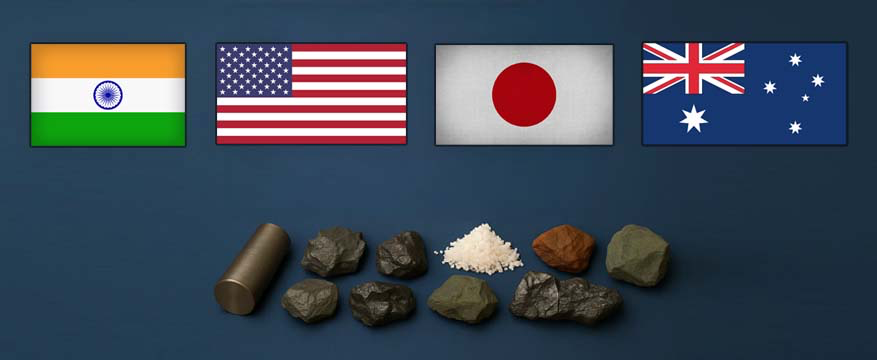
As the world moves towards clean energy, defence system upgradation, digitalisation and enhanced manufacturing, critical minerals have become an integral part of economic, energy and national security. China’s chokehold over critical mineral supply chain, especially processing and refining, is used by Beijing as a geopolitical lever. This dominance has made supply chains opaque and fragile as export restrictions, license regulations, and price manipulation can not only disrupt supply chains but also disrupt industrial ecosystems dependent on these critical minerals. The Quad grouping comprising Australia, India, Japan and the United States of America (USA) remains the best bet for reducing reliance on China as each of these four countries possess complementary strengths which, if synced can be helpful in creating a transparent and accessible critical mineral supply chain. While Australia has vast reserves of critical minerals needed for economic, energy, and national security, it also enjoys superior exploration capability, which, when combined with India’s burgeoning downstream industry, Japan’s technological capability and USA’s financial prowess along with market scale could take care every stage of the mining value chain. The Quad has made critical minerals an important part of its agenda. In 2025, its member countries launched the Quad Critical Minerals Initiative to secure and diversify the critical mineral supply chain through coordination between government and industry. In 2026, they adopted the Quad Critical Minerals Initiative Framework which plans for investment, both public and private, up to $20 billion for critical minerals supply chains, including mining, processing, and recycling. For quad this to succeed, it is essential to look for resource-rich territories and that is where the role of Central Asia becomes critical.
Central Asia is a landlocked home to several critical mineral reserves yet mostly unexplored. The region possesses 38.6% of global manganese ore reserves, 30.07% of chromium, 20% of lead, 12.6% of zinc, 8.7% of titanium, 5.8% of aluminum, 5.3% of copper, 5.3% of cobalt, and 5.2% of molybdenum, and it is also harbours significant rare earth element (REE) deposits. Kazakhstan, the largest country in Central Asia is also the largest producer of uranium. The region is one of the largest beneficiaries of China’s Belt and Road Initiative (BRI). A case study shows that infrastructural projects were instrumental in China becoming a dominant player in the critical mineral supply chains. BRI has played a key role in linking China to Europe and the Middle East, and roughly 70% of Central Asia’s critical minerals flow to China. Central Asia offers incentives for Quad members to invest as it seeks to diversify its customers. Kazakhstan in 2025 allocated $127 million for geological exploration, and in 2024, Uzbekistan announced the discovery of tungsten, germanium, lithium, and 14 new REE deposits, while Tajikistan is one of the largest global producers of antimony. Quad members have begun to work with Central Asian countries, but it is bilaterally rather than as a group. Last year, the USA signed a memorandum of understanding (MoU) with Central Asian countries and also signed a government-to-government MoU with Kazakhstan. The American mining company Cove Capital has agreed to develop a tungsten mine in Kazakhstan through a $1.1 billion investment, and the US Export-Import Bank will provide $900 million. This year, the USA signed a new MoU with Uzbekistan, building on the previous one from 2024. The USA has also given impetus to the C5+1 dialogue with Central Asian countries and, in 2024 it launched the 2024 C5+1 Critical Minerals Dialogue. Japan has played an integral role in the REE sector in Kazakhstan and recently discussed expanding cooperation across critical mineral value chain in Uzbekistan. In his meeting with Central Asian leaders, Japanese Prime Minister Sanae Takaichi committed to spending $19 billion over five years in the region, with critical minerals being an important component of this budget. India too is interacting more actively with the region. During the 4th India-Central Asia Dialogue last year, foreign ministers of Central Asian countries and India emphasised cooperation in critical minerals and in 2026, Indian Prime Minister Narendra Modi visited Uzbekistan where he emphasized critical minerals as a crucial component of the partnership between both countries. Australia has been exploring opportunities to expand ties with Central Asian countries.
However, to match China’s investment in the region, it is better for the Quad to combine their complementary strengths that include not just exploration but also technologies for building in-house processing capacity and recycling, as well as training programmes for the local workforce. The Quad could open a dialogue with the Central Asian countries and work with them, with exploration as the first priority, as these countries struggle with outdated data dating back to the Soviet era. Australia’s geoscience agencies’ expertise in identifying complex data is well-placed to spearhead mineral exploration in the region, helping to detect and map critical mineral reserves. There is also a need to combine relevant funding agencies of all Quad countries: the US Development Finance Corporation and EXIM, Japan’s JBIC and JOGMEC, India’s KABIL, and Export Finance Australia, so that they may pool their resources to set up a joint finance mechanism. This coordinated Quad effort would help not only these four countries build an effective supply chain, in spite of their often divergent geopolitical goals and economic interests, but also help Central Asia to diversify its clients and investors.



Add comment