


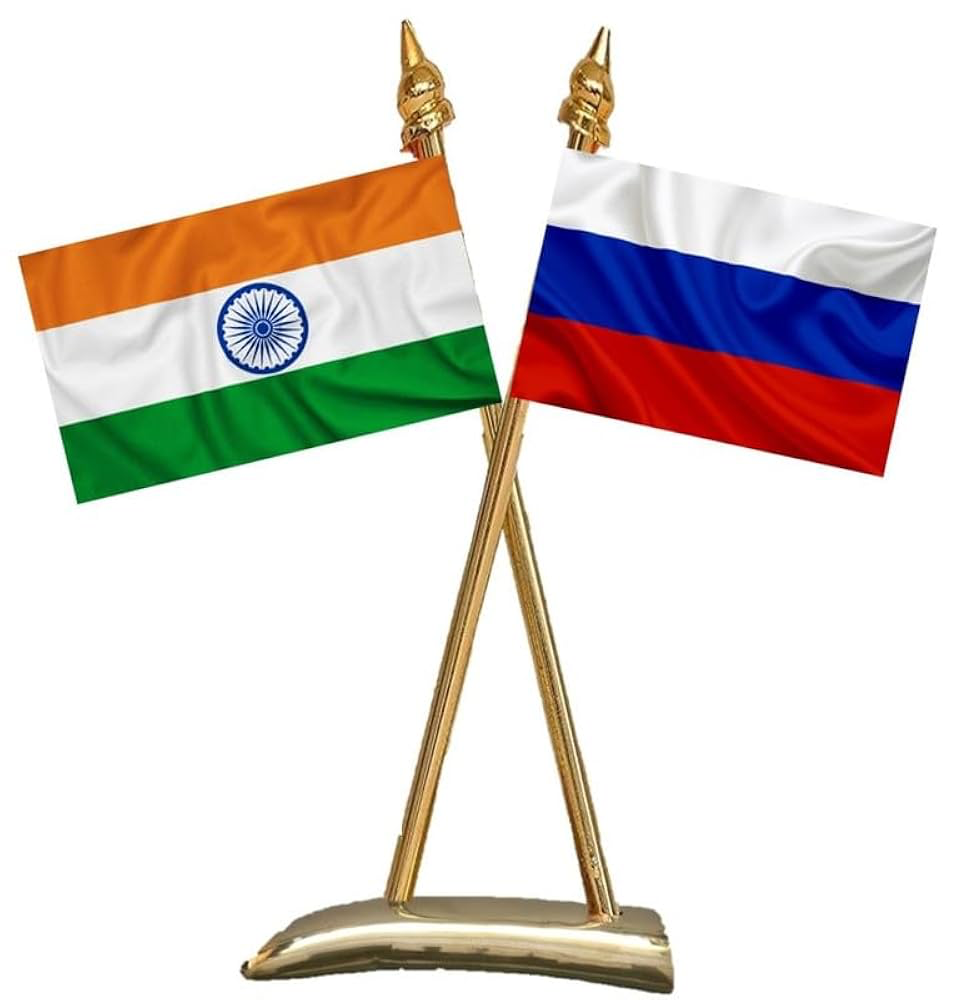
Prime Minister Narendra Modi’s meeting with Russian President Vladimir Putin on the sidelines of the Shanghai Cooperation Organisation (SCO) Summit in Bishkek on 31 August came at a pivotal moment in India–Russia relations. The two leaders are due to meet again shortly at the BRICS Summit in New Delhi, offering another opportunity to review a relationship that has remained resilient despite major geopolitical changes.
Defence would naturally have featured in the Bishkek discussions, with the two leaders reviewing the full range of the India–Russia Special and Privileged Strategic Partnership. The meeting comes as Russia seeks to renew defence cooperation with India. Moscow has reportedly responded to India’s RFP for additional S-400s and is promoting the S-500 Prometheus air-defence system and the Su-57 fifth-generation fighter. This coincides with India’s diversification of defence partnerships and its pursuit of greater indigenous capability and self-reliance.
SCO and the Bishkek Meeting
Established in 2001, the SCO has evolved from a grouping focused largely on regional security into a broader Eurasian forum covering security, counter-terrorism, connectivity and economic cooperation. India became a full member in 2017. The Bishkek Summit took place amid geopolitical uncertainty, including conflicts in Ukraine and West Asia, and concerns about energy and trade. The Modi–Putin bilateral therefore extended beyond defence, encompassing bilateral and global issues. Modi reiterated India’s emphasis on dialogue and diplomacy to resolve conflicts.
Why Defence Is Again in Focus
For decades, Russian-origin fighters, submarines, helicopters, tanks and air-defence systems were a key part of India’s military capability. That relationship is now changing. India is diversifying defence procurement while expanding indigenous production, technology absorption and private-sector participation. Yet Russia remains important. Much of India’s military inventory is still of Russian origin, and Russian systems could continue to meet immediate operational requirements, particularly in critical areas such as air power and air defence. India faces two modernising air forces across its northern and western borders. China is rapidly expanding its fifth-generation fighter capability. At the same time, deliveries of HAL’s indigenous LCA Tejas Mk1A have faced multi-year delays, with the first Mk1A squadron now expected only by March 2027.
India’s Advanced Medium Combat Aircraft (AMCA) remains years away from operational service. Indigenous long-range air-defence programmes are also still under development. India therefore faces a familiar dilemma. Self-reliance must remain the long-term objective, but immediate capability gaps cannot always wait for indigenous programmes to mature.
S-400: The Most Immediate Proposal
Unlike speculation about other Russian systems, the S-400 has seen concrete progress. India contracted five S-400 Triumf systems from Russia in 2018, which reinforced India’s layered air defence during Operation Sindoor. India has since initiated procurement of five additional S-400 squadrons. Russia has responded to India’s RFP, with its proposal reportedly under examination by the Ministry of Defence. India is also developing an indigenous long-range air-defence capability under Project Kusha. However, it will take time to mature and enter service in sufficient numbers. The S-400 proposal therefore highlights the challenge of meeting immediate operational requirements while continuing India’s longer-term drive towards self-reliance.
Beyond the S-400
Russia has also been promoting the S-500 Prometheus air-defence system and the Su-57 fifth-generation fighter. No official confirmation indicates that either was specifically discussed in Bishkek. The S-500 is intended to provide a higher level of strategic air and missile defence than the S-400. However, for India, any such acquisition would need to complement its emerging indigenous air-defence architecture rather than compete with it.
The Su-57 raises a more immediate question. India currently has no operational fifth-generation fighter, while the AMCA remains some way from induction. China already operates fifth-generation fighters and continues to expand its fleet. This raises the question of whether India needs an interim stealth capability. Russia clearly sees an opportunity and has promoted the Su-57, including the possibility of technology transfer and production in India.
The decision would require careful consideration of cost, technology and integration, particularly given India’s earlier withdrawal from the joint Fifth-Generation Fighter Aircraft programme. Moreover, modern air warfare is network-centric, and a fifth-generation fighter’s value lies not only in stealth but also in seamless integration with sensors, weapons and airborne warning and command networks.
The real question, therefore, is not whether the Su-57 can arrive before the AMCA, but rather what operational capability it would bring during the intervening period. Other areas of cooperation include the proposed upgrade of India’s Su-30MKI fleet, the modernisation and support of existing Russian-origin equipment, and possible cooperation on submarines and strategic early-warning systems.
From Buying to Building Together
The broader question extends beyond individual weapon systems. The traditional India–Russia defence relationship was built largely on India’s purchases of Soviet and Russian equipment. That model is changing as India places greater emphasis on indigenous production, technology transfer and participation by Indian industry. The question is therefore no longer: What can Russia sell India? It is: What can India and Russia build together? There are useful precedents. BrahMos has evolved from an India–Russia joint venture into a successful missile programme with an export market, while the AK-203 project at Korwa demonstrates local manufacturing through bilateral cooperation.
Future Russian proposals involving genuine technology transfer, joint development and Indian production would therefore better align with India’s priorities while helping Russia retain an important role as India diversifies its defence partnerships.
India’s Choice: Capability Without Dependence
India’s choices should not be framed as Russia versus the West, or as imports versus self-reliance. India is pursuing a pragmatic course, diversifying its defence partnerships while expanding indigenous capability. However, the terms of engagement are changing. Future acquisitions will increasingly be judged on operational capability, delivery timelines, technology transfer, indigenous content, lifecycle support, interoperability, and how well they complement India’s own programmes.
Strategic autonomy cannot rest on diversifying imports alone. It ultimately requires domestic technological and industrial capacity. The future of India–Russia defence cooperation will therefore depend less on the number of systems India purchases and more on the quality of the partnership they build.
References:
[1] “IAF Targets First LCA Tejas Mk1A Squadron by March 2027,” EurAsian Times, 28 August 2026.
[2] PIB MoD “Year End Review – 2019,” 27 December 2019.
[3] “Russia Submits Proposal for 5 More S-400 Squadrons in Response to India’s Tender,” The Times of India, 30 August 2026.
[4] DRDO information on the indigenous Long-Range Surface-to-Air Missile programme, Project Kusha, 2026.
[5] “S-500 and Su-57 on the Table: What India Could Gain from its Next Big Russia Defence Deals,” The Times of India, 1 September 2026.
[6] PIB “From Strategic Partnership to Special and Privileged Bond: India–Russia Relations,” 4 December 2025;

Add comment