


A French adage warns: the more things change, the more they remain the same. This is true of Israel’s irridentist war against Iran for the annexation of southern Lebanon, from which the United States has attempted to retreat. On June 17, 2026, US President Donald Trump signed a Memorandum of Understanding to end the war at the famous Palace of Versailles, at the instance of French President Emmanuel Macron. Simultaneously, the MoU was digitally signed by Iranian President Masoud Pezeshkian in Tehran. President Macron applauded the agreement as paving the way for “lasting peace” and the reopening of the Strait of Hormuz.
The MoU was signed in both English and Persian (Farsi), and represents a major legal victory for Iran. The Persian text is not a mere translation, but has validity and binding force in the international arena. It will therefore not be possible to interpret the English words to one’s convenience, as the Persian text stands on its own merits.
Even as President Trump was explaining the rationale for the deal to the American people, Israel launched a fresh assault in southern Lebanon on June 18, 2026. The beleaguered Israeli Premier Benjamin Netanyahu opted to hold the world economy hostage to his domestic pressures and pursuit of his Greater Israel agenda. He insisted that he intends to control all of Gaza and to continue the war in Lebanon.
Inevitably, Iran suspended the proposed 60-day negotiations that were to begin in Geneva, Switzerland, on June 19, saying the agreement is pointless if Iran is the only one adhering to its commitments. US Vice President JD Vance cancelled his trip. But the backdoor facilitators leapt into action, and on June 20, 2026, despite tensions, the US-Iran diplomatic dialogue was revived. The US and Iranian representatives arrived at Burgenstock, Switzerland, along with Qatari and Pakistani mediators. Talks took place on June 21, 2026.
Trump’s explanation
Addressing the media after signing the MoU, President Trump confirmed that Iran would get USD 300 billion for reconstruction (to be released gradually by Gulf Cooperation Council countries), and USD 100 billion in released frozen funds. He justified his actions, saying, “If I keep bombing them, the ships remain blocked. That costs 500-600M$ per day. And in 4 weeks, we won’t have any reserves [of oil] left. We wouldn’t have any. Do you want to see chaos?”
Trump added, “Iran will keep its ballistic missiles… I can’t stop them and allow Saudi Arabia to have them!” On nuclear enrichment, he said Iran must be allowed to have nuclear power for electricity and other peaceful purposes.
Trump reiterated his view that Israel should stop fighting Hezbollah in Lebanon to the Syrian President Abu Mohammed al-Jolani, “I was the one who placed al-Jolani in Syria, they say he’s violent, that he’s from Al-Qaeda…” but al-Jolani could do a better job than Israel. The news that Trump would like Al-Qaeda jihadists to invade Lebanon and fight Hezbollah as Israel’s proxies caused consternation in Arab circles.
Interestingly, President Trump claimed that he got China to refrain from openly supporting Iran and thanked President Xi, and also President Putin for staying neutral.
On the issue of Iranian assets, he told journalist Peter Doocy that messing with international norms could be catastrophic. “That money is FROZEN. We HAVE to return it. If America starts stealing other nations’ assets, the DOLLAR IS DEAD. No one will trust us again. The entire world financial system collapses.”
Vice President J.D. Vance explained that Trump felt frustrated as whenever “we seem to be right on the cusp of a major breakthrough in the agreement, and then all of a sudden there’s a major explosion … in a civilian population centre in Beirut and a lot of people who have nothing to do with Hezbollah lose their lives. That’s not acceptable.”
Vance chastised Israeli cabinet members for making personal attacks on President Trump, pointing out that Trump is the sole head of state in the world who is still sympathetic to Israel, and that it is unwise to attack their only powerful ally. Moreover, in just the past three months, the American exchequer paid for two-thirds of the weapons that protect Israel, and these were made by American labour. Exasperated at the violation of the ceasefire, Vance warned Netanyahu: “Don’t play games with us, you’re risking losing everything. Trump is your last ally, the entire world already hates you.”
Journalist Tucker Carlson studied the US-Iran MoU and commented that Israel used the war to seize land in southern Lebanon, hence the first paragraph of the MoU forces the US to pull Israel back and return territory. The US agreed to respect Iran’s sovereignty as a “great power” and to lift the naval blockade; therefore Iran opened the Strait of Hormuz, toll-free for 60 days during the proposed negotiation process. Tucker opined that the deal has officially ended America’s global dominance, “This isn’t victory. This is retreat.” Henceforth, Iran and Oman will dictate the terms of shipping through the Strait of Hormuz.
Iran again closed the Strait of Hormuz after Israel proved unrelenting in its aggression in southern Lebanon. The IRGC Navy announced that the Strait “will remain CLOSED until Israel withdraws from Lebanon, the naval blockade is fully lifted, and US forces leave the Persian Gulf and the region.” It warned that vessels defying the notice would be targeted.
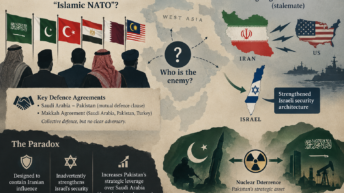
It may be mentioned that, irrespective of the ultimate fate of the Peace talks, the world’s geopolitical landscape has changed dramatically. The Gulf nations will have to come to terms with the fact that the US can no longer guarantee their defence and security, and will eventually pull its troops out of the region. Arab capitals are pondering strategic alliances with Pakistan, Russia, China, India, and Turkey.
Former US Naval veteran Michael T. Lester warned that the US Congress, in committee, quietly passed Section 224 to permanently merge US and Israeli defence research, production, and procurement into a single structure, shielded from the annual vote that currently gives Congress leverage over Israel.
Iran’s perspective
Iran was prescient in agreeing to the digital signing on June 17, before the official negotiations in Geneva on June 19, 2026. As the Iranian spokesperson explained: “When the text is signed by the highest authorities of both countries, violating it will naturally carry greater costs. Given our past experiences, we preferred that this happen.”
Supreme Leader Mojtaba Khamenei admitted having reservations but deferred to President Masoud Pezeshkian, who personally and on behalf of the Supreme National Security Council, assured that he would safeguard the rights of the Iranian nation and the Resistance Front. The Ayatullah warned that “If the US makes excessive demands on Iran at the new stage of negotiations, Tehran will not accept them.”
Iran was adamant that Israel must cease its attacks on Lebanon. It digitally signed the MoU to put the onus on President Trump to make Israel comply. Iran’s Foreign Ministry spokesman Esmaeil Baghaei said Iran will monitor US implementation “without any leniency” and will abide by its own commitments only after the other side fulfils its promises.
Iran also has a stake in splitting the Israeli-American alliance to erode the Zionist agenda for Greater Israel. The Zionist success in annexing Palestine into Israel could come unstuck in Lebanon. The Israeli Defence Minister has bragged about flattening the entire first line of villages in southern Lebanon, so that the 200,000 residents never return. This kind of gloating has turned major Western allies against Israel.
Conclusion
Russian philosopher Alexander Dugin opined that the agreement reflects “a profound fracture within the West.” While Tehran insists that the war in southern Lebanon must end, to which Donald Trump appears amenable, this clashes with Benjamin Netanyahu’s political survival strategy. As a result, the “collective West” has split into four distinct power centres: Trumpist America, Israel, Great Britain, and the European Union, facing a resolute Iran.
References
1] Iran’s supreme leader says approved US deal despite having ‘different’ view, Al Jazeera, June 18, 2026
2] Israeli strikes kill at least 47 amid intense fighting in southern Lebanon, Al Jazeera, June 18, 2026.
3] Fears for US-Iran deal as talks delayed by Israeli strikes on Lebanon, Al Jazeera, June 19, 2026.
https://www.aljazeera.com/news/2026/6/19/us-iran-talks-postponed-as-israel-attacks-lebanon
4] US-Iran talks postponed as Israel launches deadly strikes in Lebanon, BBC, June 19, 2026.
https://www.bbc.com/news/articles/c8r2eme2n5do
5] The US–Iran Peace Framework: A New Chapter in Middle Eastern Geopolitics
Abbas Hashemite, June 18, 2026
6] We Are a Long Way from a Peace Deal, Paul Craig Roberts, June 18, 2026.
7] ‘U.S. CAN’T IMPOSE ITS WILL ANYMORE’: Tucker Carlson Schools Trump & MAGA After ‘Iran Surrender’
8] Iran said ‘We closed the Strait of Hormuz’, the US set a date for talks, En.Haberler.com, June 20, 2026.


Add comment